Posted November 23, 2026 | by James Phifer
You’re looking at a financial report that doesn’t match what you thought your reserves held. A vendor calls to ask why an invoice from two months ago still hasn’t been paid. You spent Sunday afternoon reconciling your own delinquency records because the numbers your management company sent didn’t add up.
That’s what it looks like when an association has bookkeeping support but not real HOA accounting. It’s more common than it should be.
Most boards settle for bookkeeping-level support because that’s what their management company provides. Transactions get recorded, expenses get categorized, a statement arrives every month. All useful. None of it is the same as accounting, and the gap is where boards get hurt.

What’s the difference between HOA accounting and bookkeeping?
Bookkeeping is recording. Data entry, categorization, basic reconciliation.
Accounting is interpretation under a recognized standard. It asks whether the entries are correct, whether the statements reflect what the association actually owns and owes, and whether the controls behind them hold up.
CPA-level oversight adds the third layer. A licensed professional designs the internal controls, supervises the people applying them, and reviews the financial statements before your board ever sees them.
Those are three different jobs. Your board makes real decisions from these numbers, and if the numbers were produced without a standard and without review, you have no way to know what you’re missing.
Why HOA financial management is harder than it looks
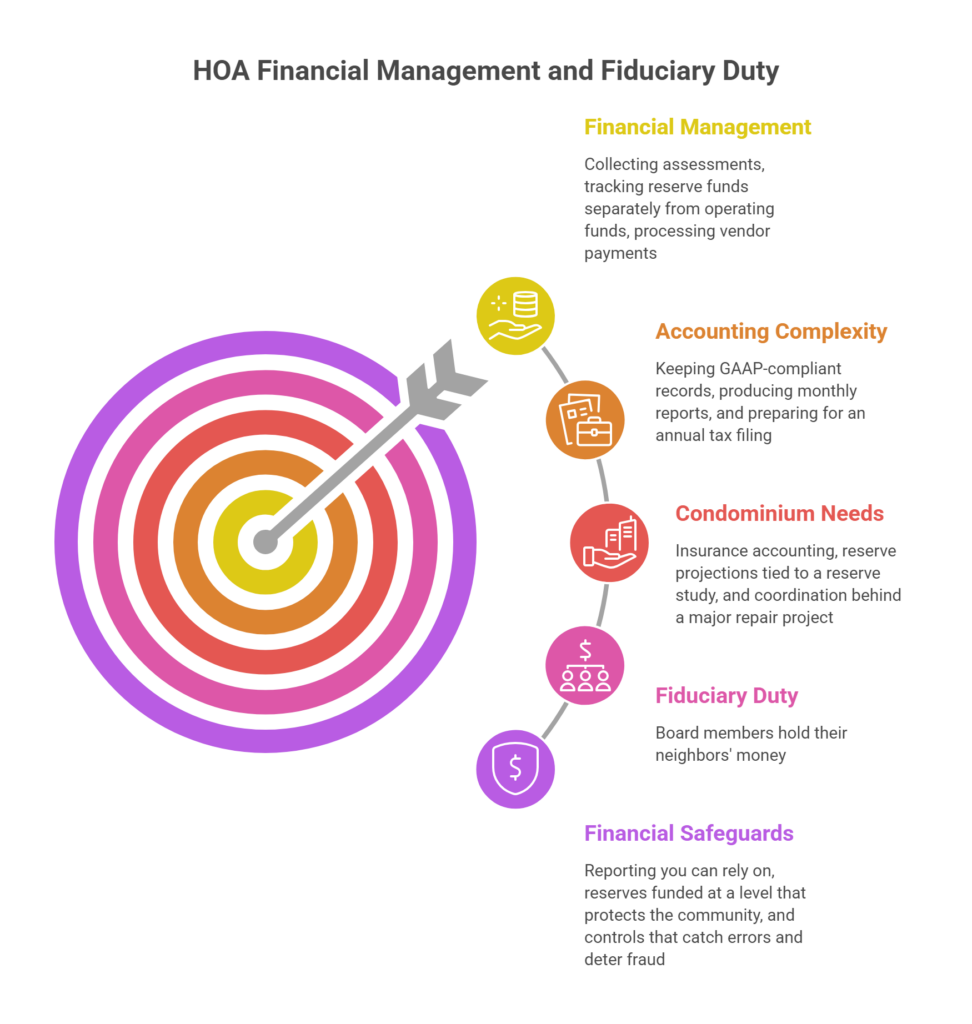
HOA financial management isn’t one task. Your association is collecting assessments, tracking reserve funds separately from operating funds, processing vendor payments, keeping GAAP-compliant records, producing monthly reports, and preparing for an annual tax filing. Those run at the same time, all year, each with its own rules.
Condominiums add more. Insurance accounting, reserve projections tied to a reserve study, and the coordination behind a major repair project take more than data entry. No two communities are the same, and a financial function built for volume can’t handle that.
Here’s the part that catches boards off guard. When the accounting stops at bookkeeping, you usually can’t tell. The reports look like reports. The columns balance. The problem surfaces later, on somebody else’s timeline.
The fiduciary duty behind the numbers
Board members hold their neighbors’ money. That’s the legal reality of the job.
That duty needs three things from your financials: reporting you can rely on, reserves funded at a level that protects the community, and controls that catch errors and deter fraud. A bookkeeper tells you what happened. A CPA tells you whether what happened was correct.
We’re your agent, and it’s your community. Part of being a good agent is building a financial function your board can defend to the homeowners who elected it.
Bookkeeper vs. accountant vs. CPA for an HOA
The distinction comes up in almost every intro call we take, so here it is side by side.
| Function | Bookkeeper | Accountant | CPA |
|---|---|---|---|
| Primary role | Records transactions | Analyzes and reports | Designs controls, reviews, advises |
| GAAP application | Not required | Usually, not certified | Yes, to a professional standard |
| Designs internal controls | No | Sometimes | Yes |
| Reviews statements before release | No | Yes | Yes, under license |
| Supports an outside audit | No | Limited | Yes |
| Reserve funding analysis | No | Sometimes | Yes |
| Fraud prevention role | Minimal | Moderate | Structured and ongoing |
| Licensing | None required | Varies by state | State licensed, continuing education required |
Most management companies staff with bookkeepers or unlicensed accounting employees and describe the department in language that sounds bigger than it is. There’s a fast test. Ask who reviews your financial statements before they’re sent to the board. If nobody can name a licensed CPA, you have a bookkeeping function.
What we see when accounting stops at bookkeeping
These are the patterns that show up when a community comes to us from a bookkeeping-only shop.
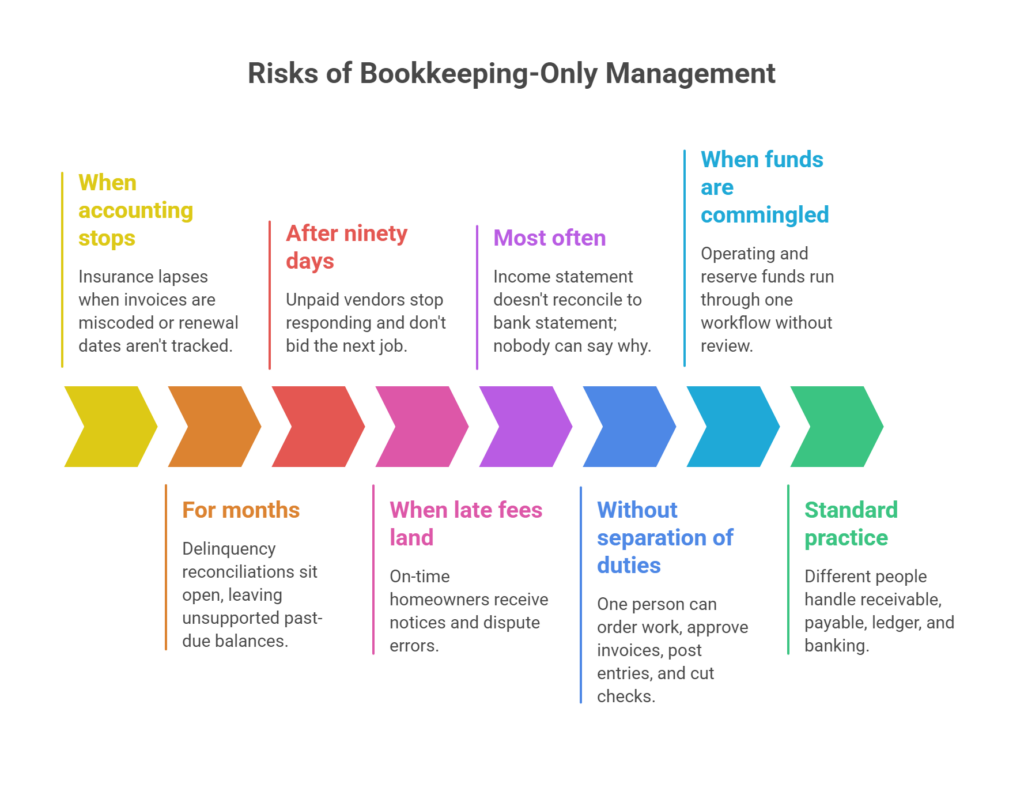
Insurance lapses because a premium invoice got miscoded or a renewal date wasn’t tracked. Manager turnover is usually in the story somewhere. Someone inherits an account with no control structure behind it and the critical date falls through the floor.
Delinquency reconciliations sit open for months. The report shows a past-due balance and the account history doesn’t support it. Nobody has the authority or the training to fix the ledger, so the board asks the same question at four meetings running and never gets a straight answer.
Vendors stop responding. Invoices that aren’t routed through an approval workflow don’t get paid, and a vendor who waited ninety days for a check doesn’t bid the next job. Then the board starts calling vendors directly to find out why work hasn’t started. That isn’t a board function.
Late fees land on the wrong accounts. A homeowner who paid on time gets a notice, calls to dispute it, and nobody can explain the error. Hours of everyone’s time to undo something a clean accounts receivable process prevents outright.
And the one boards describe most often: the income statement doesn’t reconcile to the bank statement, nobody at the management company can say why, and the board is told to trust the numbers anyway.
Separation of duties, and what happens without it
This is where bookkeeping-only models carry real risk, not theoretical risk.
When one person or one small team orders the work, approves the invoice, posts the entry, and cuts the check, there’s no structure standing between your association’s money and a mistake. Someone who approves invoices and signs checks can pay themselves. Someone who posts transactions and reconciles the bank statement can bury an error for a year.
Commingling is the other exposure. Operating funds and reserve funds belong in separate accounts with separate tracking, and the point of keeping them apart is that reserve money stays available for the roof it was collected for. When a bookkeeping function runs everything through one workflow with no review layer, the separation exists on the statement and not much of anywhere else.
Separation of duties means accounts receivable, accounts payable, general ledger, and banking sit with different people. Nobody controls a transaction end to end. That structure is standard practice in accounting, and it’s what a CPA is trained to build and supervise.
How our CPA-led HOA accounting works
Financials in this industry needed to be done better, so we took on the expense of bringing a licensed CPA into the company. He doesn’t only handle ACCU’s corporate books.
His oversight extends to the financials for the associations we manage, so the process behind your statements was built to a CPA’s standard. When our team has a question about why a number looks the way it does, they have someone who understands the why.
The department under him separates the work. Accounts receivable, accounts payable, the general ledger, and banking each sit with a different person, and each role has a defined scope. We’re GAAP compliant, and we run accrual basis, so your income statement shows what the association has earned and what it owes rather than only what moved through the bank last month.
James Phifer, our owner, describes the result plainly: on time and no problems. “It’s like, easy button.” Boards stopped asking the same question every month and started getting statements they could work from.
Our board portal is the other half. You get live access to bank balances, paid invoices, GL codes, and financial reports, at any hour, without calling anyone. You can pull up a paid invoice and see the approval behind it. That’s what transparency has to mean, or it’s just a word on a website.
If you want more on how to read what you find in there, our guide to understanding HOA financial reports is a practical place to start, and our post on understanding your HOA’s cash flow covers the two numbers we tell boards to watch first.
Where our CPA stops and an outside firm starts
We want to be clear about this, because plenty of companies aren’t.
We don’t prepare your tax return and we don’t audit your association. Your tax filing goes to an outside accounting firm, and we’re glad to recommend a few. If your board wants an audit, and many communities do one every few years, that’s an independent CPA firm as well. It has to be independent to be worth anything, and a firm reviewing books produced by its own affiliate isn’t independent.
What CPA oversight does is hand that outside firm clean, GAAP-basis, reconciled books, with a control structure they can actually test. Boards who’ve been through an audit on messy records know what the difference costs.
Our HOA accounting services page covers the full scope of what we do and don’t handle in-house.
The real cost of cheap accounting
Boards pick management companies on monthly fee, and accounting quality rarely makes the scorecard. The bill shows up later.
Errors compound quietly. Without review and separation of duties, small mistakes stack for months before anyone notices, and the reconciliation work to unwind them costs more than the oversight would have.
Reserve funding drifts. A reserve study tells you what to save, and a bookkeeper records the deposit, but somebody has to confirm the contributions actually match the study and that the money is classified where it belongs. When that doesn’t happen, the community pays for it in a special assessment. Those cost money and they cost trust.
Then there’s your Wednesday night. If you’re reviewing invoice approvals or checking whether a delinquency report is accurate, that’s not board work. That’s a signal about who’s doing the accounting.
For more on what sound financial practice looks like over a full operating year, see our HOA financial management best practices.
Questions to ask your management company
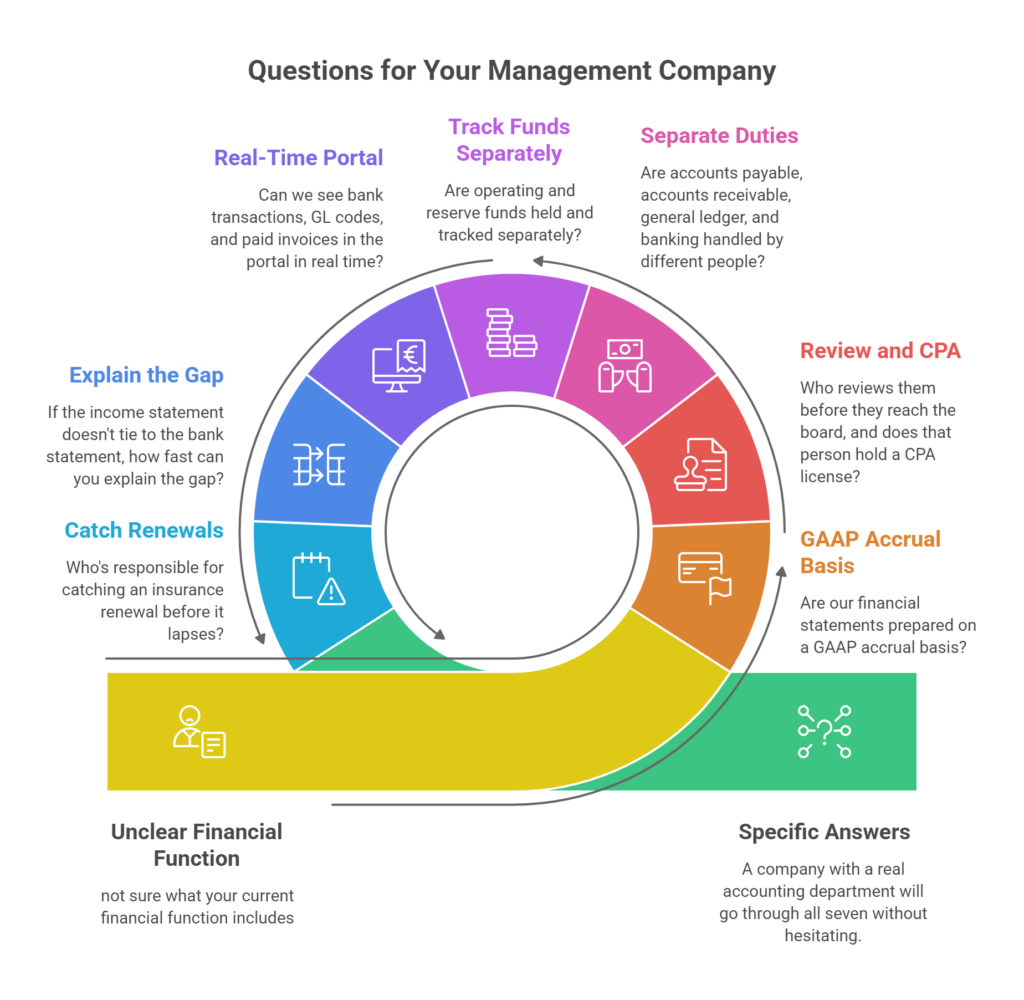
If you’re not sure what your current financial function includes, ask these and listen for specifics.
- Are our financial statements prepared on a GAAP accrual basis?
- Who reviews them before they reach the board, and does that person hold a CPA license?
- Are accounts payable, accounts receivable, general ledger, and banking handled by different people?
- Are operating and reserve funds held and tracked separately?
- Can we see bank transactions, GL codes, and paid invoices in the portal in real time?
- If the income statement doesn’t tie to the bank statement, how fast can you explain the gap?
- Who’s responsible for catching an insurance renewal before it lapses?
Vague answers are an answer. A company with a real accounting department will go through all seven without hesitating.
For a broader look at what the work includes, we cover it in HOA accounting services explained.
HOA CPA services: questions boards ask us
-
Does every HOA need a CPA?
Not every association is required to hire one directly. Many governing documents call for a periodic audit or review, and that has to be performed by a licensed CPA firm. Beyond the documents, any community holding meaningful reserves, running capital projects, or managing a long vendor list has a practical need for CPA-level oversight. Check your declaration and your state requirements together.
-
What does a CPA do that a bookkeeper can't?
A bookkeeper records transactions. A CPA designs the internal controls, supervises the staff applying them, reviews statements for accuracy before release, prepares the association for an outside audit, and advises the board on reserve funding and long-term financial health. Different jobs. Most boards don't notice the second set is missing until something breaks.
-
How do I know if our accounting is GAAP-compliant?
Ask directly whether your statements are prepared on an accrual basis under GAAP. If the answer is unclear, or your financials are cash basis only, you probably don't have GAAP reporting. A licensed CPA reviewing the statements before they go to the board is the clearest sign the standard is being applied.
-
Does CPA-level accounting cost more than bookkeeping?
It costs more to staff. What it saves is errors nobody has to unwind, reserves that are actually where the study says they are, and assessments that don't arrive as a surprise. Boards that have lived through a reserve shortfall or a lapsed policy don't usually describe proper accounting as expensive afterward.
See what this looks like in your community
We’ve been doing this since 1979, still family owned, still local. We’re not private equity and we’re not trying to scale for the sake of scaling, which is part of why we could justify putting a licensed CPA over the accounting department instead of adding more accounts per person.
If what you’ve read here sounds different from what you’re getting now, request a proposal and we’ll walk you through how your association’s financials would actually be handled.
Call us at (303) 733-1121 or email support@accuinc.com.
CPA-level accounting isn’t a premium tier. For a board with a fiduciary duty, it’s the floor.
About James Phifer
James Phifer is the owner and CEO of ACCU, Inc., a family-owned Colorado community association management company in business since 1979. With 22 years of experience, he specializes in turning around aging, under-reserved condominium communities through disciplined budgeting, reserve planning, and insurance claims strategy, and he teaches boards across the country through his HOA Life platform. Read James’s full bio here.