Posted November 24, 2026 | by James Phifer
Too many boards know the feeling. You call your management company and days go by. You ask for three bids and get one. A work order disappears into the portal and comes back months later marked resolved, with no note about who fixed it or when.
That’s usually not a bad manager. It’s a staffing model that asks one person to do two jobs at once.
Every community we serve through our HOA community management services gets a dedicated Community Association Manager and a dedicated Assistant Community Association Manager, working as a paired team.
Here’s what each one does and why we built it that way.
The short answer
Every ACCU-managed community is assigned both a Community Association Manager, or CAM, and an Assistant Community Association Manager, or ACAM. The manager and assistant work the same community as a coordinated team.
This isn’t a premium tier or an upgrade you select. It’s standard on every full-service management account from day one.
Why one manager can’t do this job well
Board-level strategy and daily homeowner volume are two different workloads running on two different clocks. One needs uninterrupted preparation time. The other needs somebody in the office answering the phone right now.
When a single person handles board meetings, monthly financials, vendor bids, inspections, homeowner calls, work orders, ARC requests, and violation notices across a full portfolio, something gives. Usually it’s the daily work.
Boards tell us the same story when they come to us. Quotes they have to chase. Work orders that sit. Stretches where nobody was actively assigned to their community at all. Then the board absorbs the difference, which is the part that stings, because joining a board was never supposed to mean taking a second job.
What the community association manager does
Your CAM is the board’s primary partner. James Phifer, our owner and CEO, describes the role as focusing on the four corners of the management agreement.
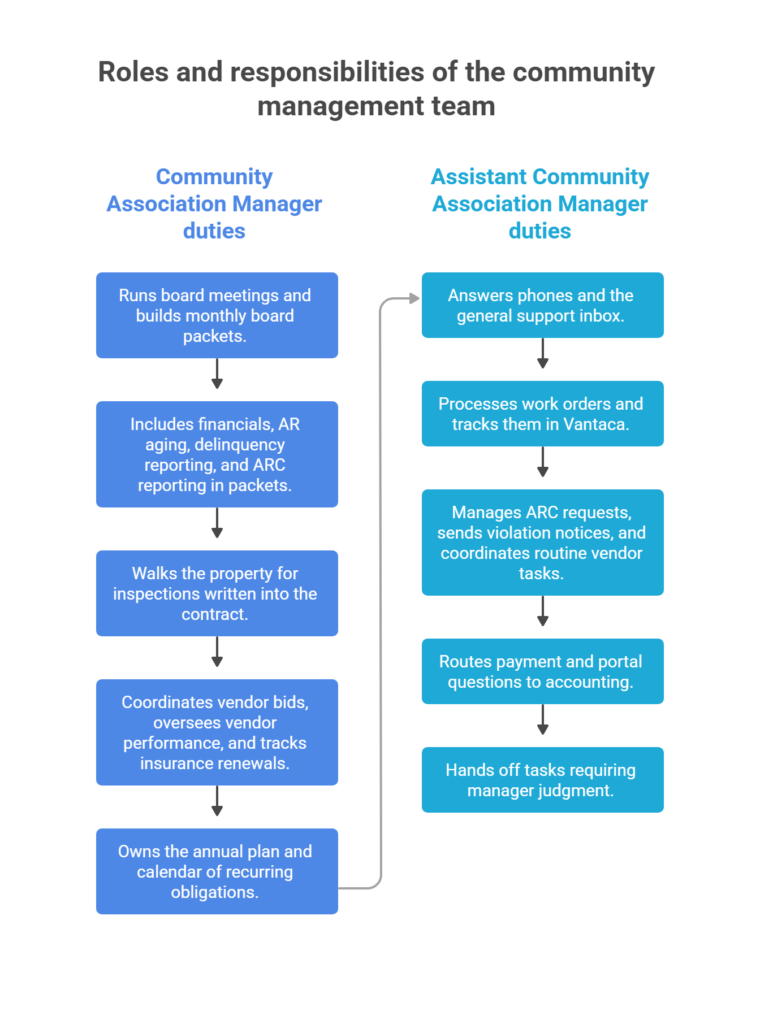
In practice, your manager runs your board meetings and builds your monthly board packet. That packet includes your financials, AR aging, delinquency reporting, and ARC reporting, and it comes whether or not a meeting is scheduled that month. Where inspections are written into your contract, your manager is the one walking the property.
Your manager also coordinates vendor bids, oversees vendor performance, and tracks insurance renewals so the window doesn’t close on you.
And your manager owns the annual plan, the calendar of recurring obligations that keeps items from slipping year to year. We build that plan before we take over management of a community, so your manager starts out knowing what your board expects instead of learning it six months in.
What the assistant community association manager does
Your ACAM is the owner-facing half of the team. They answer the phones and the general support inbox, so a homeowner with a question gets a person rather than a queue.
They process work orders and track them in Vantaca, our management platform, where every action is timestamped and visible to the board in real time. They manage ARC requests, send violation notices, coordinate routine vendor tasks, and route payment and portal questions to the right person in accounting.
When something sits above their scope or needs the manager’s judgment, they hand it up and your manager takes it from there.
That split is deliberate. If you’re asking what the roles and responsibilities of an assistant manager in an HOA should be, the honest answer is that the ACAM carries the daily operational load. At a lot of companies, that load lands on the manager instead, or on the board.
A normal Monday
A homeowner submits an ARC request through the portal. Your ACAM acknowledges it that day and opens the ticket. Meanwhile your CAM is closing out Tuesday’s board packet and chasing the second and third bids on a parking lot repair.
Both get done, because neither person is being pulled in two directions.
Manager and assistant roles and responsibilities, side by side
| Community Association Manager (CAM) | Assistant Community Association Manager (ACAM) |
|---|---|
| Runs board meetings and builds the monthly board packet | Answers homeowner calls and the general support inbox |
| Conducts property inspections where contracted | Processes work orders and tracks them in Vantaca |
| Solicits and compares vendor bids | Manages ARC requests and communicates decisions |
| Tracks insurance renewals and coverage timelines | Issues violation notices and follows up |
| Owns the annual plan and board-level reporting | Routes billing and portal questions to accounting |
If you want to go deeper on workload, our post on how many communities does a manager handle covers what a sustainable portfolio actually looks like.
What happens when your manager isn’t available
This is the fear we hear most, and it isn’t about day-to-day service. It’s about the month your manager is out, or the quarter after they resign, when the community knowledge walks out the door with them.
Two people in the community solves that structurally. Your ACAM knows the open work orders, the homeowners with pending questions, and the vendor conversations in progress. If your manager is onsite somewhere else, work still moves.
We protect it a second way. When a community has a major capital project or an insurance claim, that project goes to Karli Phifer, our COO, who ran a construction defect law firm before joining us. She takes the bid specifications, the contractor vetting, and the timeline, so your manager doesn’t get pulled off your community for six months to run somebody else’s roof replacement.
Across departments, our turnover is low. That isn’t luck, and it isn’t a perk we advertise. It’s what happens when the job is actually doable.
The team behind the team
Your CAM and ACAM don’t work alone. Behind them is our in-house GAAP accounting department: a dedicated accounts receivable specialist, an accounts payable specialist, a GL accountant, a banking specialist, and a licensed CPA, Robert Raak, who serves as our CFO.
Roles are separated on purpose. AR handles delinquencies, payment plans, and owners who can’t get into the portal. AP codes every invoice to the right association and the right general ledger line. Nobody holds all of it.
That’s how a community ends up with a five to seven person team working on its behalf, even though the board communicates mostly with two of them. More on how the full HOA community management services structure works on our community management page and our consulting and accounting services page.
Why we staff this way
Our mission is “Business Management for your Association, Neighborhood Management for Homeowners. Doing the right thing for our team and your community.”
That last clause is doing real work here. One manager carrying every task across multiple communities burns out. Burned-out managers leave. When managers leave, boards go months without coverage, meet a new face every year, and lose the institutional knowledge that makes management function at all.
One of our five core values reads, “We do what we say we’re going to do.” A staffing model that sets managers up to fail makes that value impossible to keep. We’ve been in business since 1979, and the model is part of why. You can read more about ACCU, or meet the ACCU team.

Frequently asked questions
-
What is the difference between a community manager and an assistant community manager in an HOA?
The CAM owns board relationships, governance, financial oversight, and vendor management. The ACAM owns the owner-facing daily work: phone calls, support emails, work orders, ARC requests, and violations. Both are assigned to your community and work as one team.
-
Do all HOA management companies assign both a manager and an assistant?
No. Plenty assign one manager to a large portfolio with little or no dedicated support. Ask the question directly during your search, and ask it before you sign.
-
Who should I contact first, the manager or the assistant?
For work orders, ARC requests, violation questions, and general homeowner inquiries, start with your ACAM. For governance, board agenda items, major projects, and contract questions, go to your CAM. Our post on communicating with your community association manager breaks that down further.
-
How does the model prevent gaps in service?
Both people are active in your community every week, so there's no single point of failure. If one is unavailable, the other already has the context and the relationships to keep things moving.
More answers on our HOA management FAQs page.
Questions worth asking before you renew
Does my community get a dedicated manager and a dedicated assistant, or one person covering both? What happens to my community when that person is out or leaves? How many communities does each of your managers carry right now? And when a homeowner calls your main number, who picks up: my manager, my assistant, or a call center that has never heard of my community?
If the answers come back vague, that tells you something.
See what two people looks like
We’ve managed Colorado HOA and condominium associations since 1979, from Boulder south to Castle Rock, with most of our work across the Denver metro area. Every community we serve gets a manager and an assistant from day one.
Request a proposal and compare it to what your community is getting now.
About James Phifer
James Phifer is the owner and CEO of ACCU, Inc., a family-owned Colorado community association management company in business since 1979. With 22 years of experience, he specializes in turning around aging, under-reserved condominium communities through disciplined budgeting, reserve planning, and insurance claims strategy, and he teaches boards across the country through his HOA Life platform. Read James’s full bio here.